



About EGSH
Eligibility and Legal Framework for Corporate Property Ownership in Dubai
A business registered in the UAE can purchase residential property in Dubai's designated freehold areas, subject to the ownership rules established under Law No. (7) of 2006 Concerning Real Property Registration in the Emirate of Dubai and Regulation No. (3) of 2006 Determining Areas for Ownership by Non-UAE Nationals of Real Property in the Emirate of Dubai.
The Dubai Land Department (DLD) charges a standard transfer fee of 4% of the purchase price, and the property is registered under the company's name on the title deed. Eligibility depends on the company's structure, jurisdiction of incorporation, and ultimate beneficial ownership, with UAE mainland and approved free zone entities having the broadest access.
EGSH, as an authorised DLD Real Estate Registration Trustee Centre, processes corporate property ownership transfers and title deed transfers for businesses purchasing residential real estate in Dubai.
Register Property Ownership Transfer in Dubai
Officially regulated fees
No hidden charges
Queue-free service
VIP support at no extra cost
From AED 2,100
Legal Framework for Corporate Property Ownership in Dubai
The right of corporate entities to own real property in Dubai is governed by Law No. (7) of 2006, which requires all real property transactions to be registered with the DLD. Any disposition of real property that is not registered has no legal effect. This rule applies equally to individual and corporate buyers.
For companies with foreign ownership, meaning any shareholders who are not UAE or Gulf Cooperation Council (GCC) nationals, property acquisition is limited to designated freehold areas, as defined in Regulation No. (3) of 2006. These areas include prominent locations such as Dubai Marina, Palm Jumeirah, Downtown Dubai, Business Bay, Jumeirah Village Circle (JVC), Arabian Ranches, and Dubai Hills Estate. The DLD maintains the official register of designated freehold zones and updates it periodically through Ruler's decrees.
Companies wholly owned by UAE or GCC nationals are not subject to the freehold area restriction and may acquire property anywhere in the emirate.
There is no legal distinction between residential and commercial property when it comes to corporate eligibility. A business entity that meets the ownership criteria for a designated freehold area may purchase a residential apartment, villa, townhouse, or land plot, provided the property falls within such a zone. However, corporate buyers should note that residential properties purchased by a company must generally be used for residential purposes only, as zoning and land-use regulations administered by the Dubai Municipality and the Real Estate Regulatory Agency (RERA) restrict the conversion of residential units to commercial use without specific approval.

Get DLD Services in Dubai Through EGSH
Authorised One-Stop Government Services Centre
- All government services in one place
- Completed in one visit
- VIP service without queues
- Regulated government fees

Eligibility by Company Type
Not every business structure carries the same property ownership rights in Dubai. The DLD applies different rules depending on whether the company is a UAE mainland entity, a free zone company, or a foreign-incorporated business. Understanding these distinctions is essential before proceeding with a residential property purchase.
UAE Mainland Companies
A limited liability company (LLC) or other corporate entity licensed by the Dubai Department of Economy and Tourism (DET) can purchase residential property in designated freehold areas. Following the enactment of Federal Decree-Law No. 32 of 2021 on Commercial Companies, which came into force on 2 January 2022, most mainland business activities now permit 100% foreign ownership without a local sponsor. This means a mainland LLC fully owned by foreign nationals can hold residential real estate in its corporate name, provided the property is located in a designated freehold area.
The DLD requires mainland companies to present a valid trade licence, Memorandum of Association (MoA), and a board resolution authorising the purchase. EGSH facilitates mainland company formation and subsequent property registration through its authorised DLD trustee centre, allowing businesses to complete licensing and real estate procedures under one roof. For a detailed overview of the company formation process, including activity selection, licensing fees, and post-incorporation obligations — mainland company formation in Dubai.

Free Zone Companies
Free zone companies can purchase residential property in Dubai, but only if the relevant free zone authority has a Memorandum of Understanding (MoU) with the DLD. The DLD recognises entities incorporated in certain free zones, including the Jebel Ali Free Zone Authority (JAFZA), the Dubai Multi Commodities Centre (DMCC), and the Dubai International Financial Centre (DIFC), among others. Companies registered in free zones without DLD recognition cannot hold property directly.
For businesses considering a free zone structure specifically for property holding, EGSH provides free zone company setup services and can advise on which jurisdictions are approved by the DLD for real estate ownership. Free zone entities must also present a valid certificate of incorporation, MoA, and a no-objection certificate from the free zone licensing authority confirming permission to acquire property.
Foreign Companies
A company incorporated outside the UAE cannot directly purchase residential property in Dubai. The DLD does not register title deeds in the name of foreign-incorporated entities. To acquire residential real estate, a foreign company must establish a UAE-registered subsidiary — either a mainland LLC or a company within a DLD-approved free zone — and register the property under that local entity.
This requirement applies regardless of the property's location within a freehold zone. The process typically involves company registration in Dubai, followed by the standard DLD property transfer procedure. EGSH assists foreign investors with both the business setup and the subsequent property registration, consolidating the process through a single authorised centre.



Why Choose EGSH for Government Services in Dubai

VIP Service
Personal assistance and priority processing with no queues.

Affordable Fees
Official government rates with transparent, fixed pricing.

All Services in One Place
Comprehensive range of UAE government services under one roof.

One-Visit Completion
Most procedures are completed in a single visit to the centre.
Required Documents for Corporate Property Purchase
The DLD requires corporate buyers to present a specific set of documents at the time of registration. The exact requirements differ slightly depending on the company type. All documents must be current and valid at the time of the transaction.
Documents for UAE Mainland Companies
A mainland entity purchasing residential property must submit the following documents: a valid trade licence issued by the DET or the relevant emirate licensing authority; the Memorandum of Association (MoA) and any amendment annexes; a board resolution or shareholder resolution authorising the property purchase and naming the authorised signatory; a valid passport of the authorised signatory; an Emirates ID of the authorised signatory (if applicable); and an Ultimate Beneficial Owner (UBO) declaration.
Documents for Free Zone Companies
A free zone company must submit: a certificate of incorporation or free zone licence; the Memorandum of Association (MoA) and articles of association; a no-objection certificate from the free zone licensing authority permitting property acquisition; a board resolution authorising the purchase; a valid passport and Emirates ID of the authorised signatory; and a UBO declaration.

Documents for Foreign Companies Purchasing Through a UAE Subsidiary
In addition to all documents required for the UAE subsidiary (as above, depending on whether it is a mainland or free zone structure), the following are required from the parent foreign company: a certificate of incorporation of the parent company (attested and translated into Arabic if required) and a board resolution from the parent company authorising the subsidiary to acquire property.
All corporate documents submitted to the DLD must accurately reflect the current shareholders, authorised signatories, and company structure. Discrepancies or expired documents will result in rejection at the trustee office. EGSH reviews corporate documentation for completeness before the registration appointment, reducing the risk of delays.

Registration Process for a Corporate Property Purchase
The process of registering a residential property in a company's name follows the standard DLD procedure but requires additional corporate documentation. Company purchases follow the same property transfer process as individual transactions, with additional documentation for the corporate entity.
The following steps outline the typical sequence.
Step 1 — Company Pre-Registration with the DLD
Before a company can purchase property, it must be registered in the DLD's company registry. This is a one-time procedure that records the company's details in the DLD system. The DLD's company registration service requires submission of the trade licence, MoA, and identification documents of the owner or authorised representative. Free zone companies must also provide a no-objection certificate from the licensing authority.
Step 2 — Agreement on Terms and Signing the SPA
The corporate buyer and the seller agree on the purchase price and terms. A Sale and Purchase Agreement (SPA) is signed, typically following the execution of a Memorandum of Understanding (Form F) and the payment of a 10% deposit held by the real estate agency or conveyancer.

Step 3 — Obtaining the Developer NOC
For properties within master-planned communities, the seller must obtain a No Objection Certificate from the developer confirming that all service charges and developer obligations have been settled. The NOC is typically valid for 30 days.
Step 4 — Transfer at the DLD Trustee Office
Both parties attend an authorised Real Estate Registration Trustee Centre, such as EGSH, with all required documents to complete property ownership transfer through DLD. The trustee office processes the transfer, collects the DLD fees, and submits the transaction to the DLD for registration. Upon approval, the DLD issues a new title deed in the company's name.
Step 5 — Title Deed Issuance
The DLD issues an electronic title deed and property map registered under the company's legal name. The title deed serves as the official proof of ownership and is required for any future transaction involving the property, including sale, mortgage, or lease.

Visit EGSH for VIP Service Without Queues
You can stop by EGSH during working hours without an appointment or book your visit at a time that suits you best.
Address
Art of Living Mall, Al Barsha 2, Dubai
Operating hours
Monday–Thursday, Saturday: 9:00 am–5:00 pm
Friday: 9:00 am–12:00 pm, 2:00 pm–5:00 pm
Sunday: Closed

Corporate Tax Implications of Company-Owned Residential Property
Since the introduction of the UAE Corporate Tax under Federal Decree-Law No. 47 of 2022 on the Taxation of Corporations and Businesses, companies holding residential property must consider the tax treatment of any income or gains arising from the asset.
The standard corporate tax rate is 9% on taxable income exceeding AED 375,000 per financial year, with a 0% rate applied to the first AED 375,000 of taxable income. This applies to all UAE mainland companies and to free zone entities that do not meet the conditions for Qualifying Free Zone Person (QFZP) status.
The following points are relevant for companies holding residential property.
Rental income generated by a company from a residential property it owns is treated as business income and is subject to the 9% corporate tax rate on profits exceeding AED 375,000. The Federal Tax Authority (FTA) considers this income part of the company's taxable activities.

Capital gains realised on the sale of a residential property by a company are also included in the company's taxable income. There is no separate capital gains tax in the UAE, but the gain forms part of the company's net profit for corporate tax purposes.
Long-term residential leases (standard tenancy contracts) are exempt from Value Added Tax (VAT) at 5%, as residential rental income is a VAT-exempt supply under UAE law. However, short-term holiday home rentals or serviced apartments may attract VAT if the annual taxable turnover exceeds AED 375,000.
Small business relief is available for companies with revenue under AED 3 million, allowing them to elect zero taxable income for qualifying tax periods through 31 December 2026, subject to the conditions set out in Ministerial Decision No. 73 of 2023.
Corporate buyers should consult a qualified tax adviser to assess the specific implications of holding residential property through a company structure, particularly where rental income, resale, or multi-entity structures are involved. Tax obligations, including registration with the FTA via the EmaraTax platform, are the company's responsibility and are separate from the DLD registration process.

H2: Practical Considerations for Businesses Buying Residential Property
Beyond the legal and regulatory requirements, corporate buyers should consider several practical factors before purchasing residential property in Dubai.
Asset protection is one of the primary reasons businesses choose to hold property in a corporate name. A company acts as a separate legal entity, meaning the property is ring-fenced from the personal liabilities of the shareholders. This can be advantageous for investors managing multiple assets or operating in sectors with higher commercial risk.
Succession planning is significantly simpler with corporate-held property. Rather than transferring a title deed through the DLD's inheritance procedures , which may require court orders, probate, and attestation, ownership of the property can be transferred by selling or assigning shares in the holding company. This avoids the DLD transfer fee of 4% that would apply to a direct property transfer, although the share transfer itself may have tax or regulatory implications depending on the company structure.
Use restrictions apply to residential property regardless of the buyer's identity. A company may not use a residential apartment or villa as an office, warehouse, or commercial premises without obtaining a change-of-use approval from the Dubai Municipality and RERA. Violations of zoning regulations may result in fines or enforcement action.
Mortgage availability for corporate buyers may be more limited than for individual purchasers. Not all UAE banks offer mortgage products to companies purchasing residential property, and those that do may require enhanced due diligence, higher equity contributions, and stricter documentation.
Maintaining the corporate veil requires strict separation between the company's finances and the personal finances of its shareholders. If a company's bank account is used for personal expenses, or if the company lacks adequate capitalisation, courts may disregard the corporate structure in the event of a dispute.

Alternatives to Purchasing Residential Property as a Business
Not every business needs to acquire residential property outright. Depending on the company's operational requirements, alternative arrangements may be more practical or cost-efficient.
Long-term leasing is a common approach for companies that need to house employees. Commercial tenancy contracts for residential units must be registered with Ejari, the DLD's tenancy registration system, and are governed by Law No. (26) of 2007 Regulating the Relationship between Landlords and Tenants in the Emirate of Dubai. Leasing avoids the upfront capital commitment of a purchase and eliminates the 4% DLD transfer fee.
Corporate housing providers offer fully managed accommodation solutions for businesses, handling lease agreements, Ejari registration, utility connections, and maintenance. This can be a practical option for companies with rotating staff or short-term housing needs.
Investing in commercial real estate may align more closely with a company's operational needs. Office spaces, retail units, and warehouses can serve dual purposes — providing both a business premises and a long-term investment asset, without the zoning restrictions that apply to residential units.

Related Government Services
Role of EGSH in Corporate Property Transactions
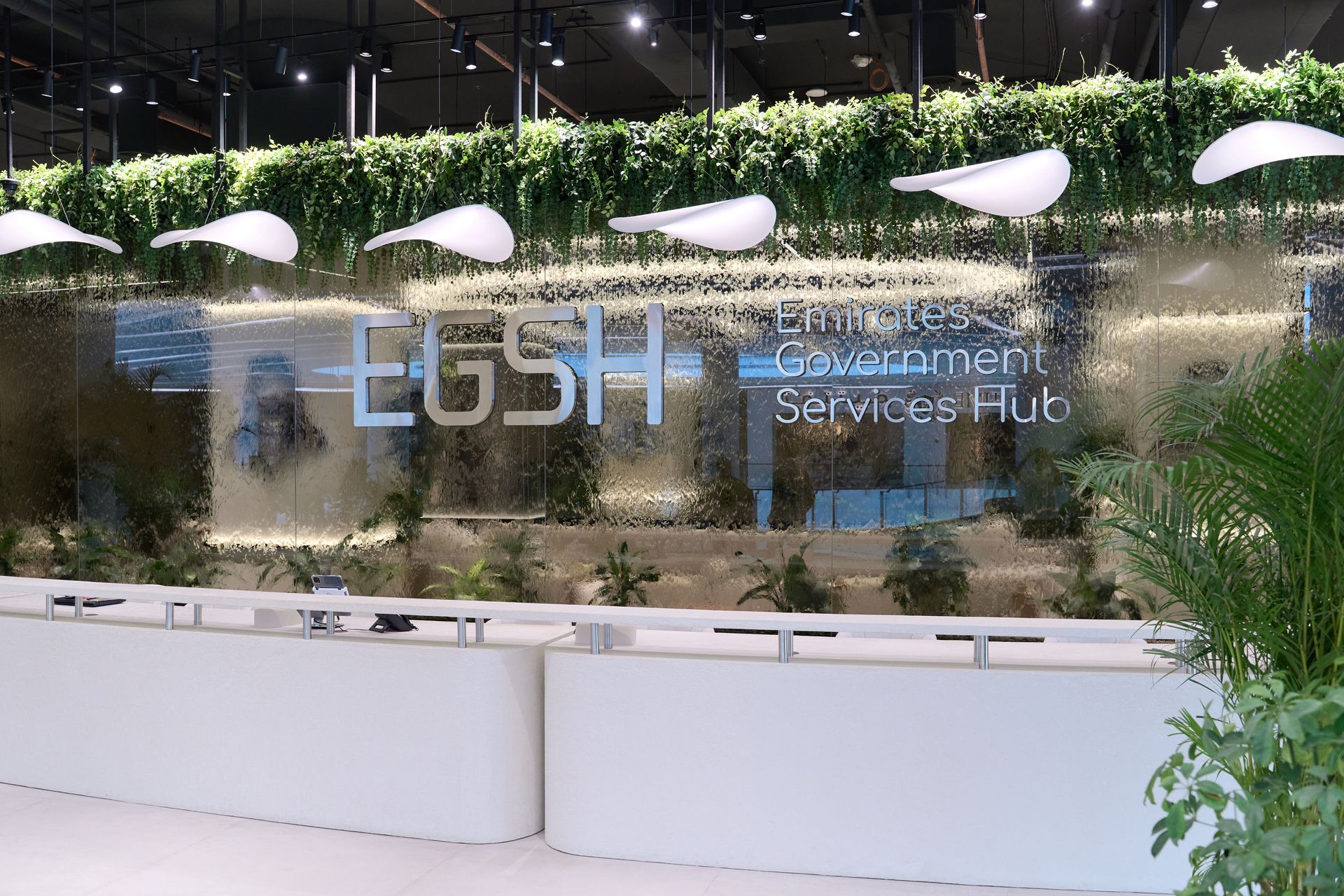
EGSH — Emirates Government Services Hub — operates as an authorised Real Estate Registration Trustee Centre and Real Estate Services Trustee Centre under the Dubai Land Department. For corporate buyers, this means that the entire property registration process, from DLD company pre-registration through to title deed issuance, can be completed at EGSH in a single visit.
EGSH also operates as an authorised Dubai Department of Economy and Tourism centre, enabling businesses to complete company registration and obtain a trade licence before proceeding to the property purchase. This consolidation of government services under one roof is particularly beneficial for foreign companies establishing a UAE subsidiary specifically to acquire residential property.
Additionally, EGSH provides authorised services for related procedures such as initial sale registration for off-plan purchases, Ejari registration for leased properties, and visa services for investors and company partners.

Frequently Asked Questions
Can a mainland LLC buy a residential apartment in Dubai?
Yes. A UAE mainland LLC can purchase a residential apartment in any designated freehold area in Dubai. The company must be registered with the DLD and present a valid trade licence, Memorandum of Association, and a board resolution authorising the purchase. The standard 4% DLD transfer fee applies.
Can a free zone company own residential property in Dubai?
A free zone company can own residential property in designated freehold areas, provided the free zone has a Memorandum of Understanding with the DLD. Free zones commonly recognised by the DLD include JAFZA, DMCC, and DIFC. A no-objection certificate from the free zone authority is required.
Can an overseas company buy residential property in Dubai directly?
No. A company incorporated outside the UAE cannot hold a title deed in its own name. The foreign company must establish a UAE-registered entity, either a mainland LLC or a company within a DLD-approved free zone, and register the property under that local subsidiary.
What fees does a company pay when buying residential property in Dubai?
The fees are the same as for individual buyers. The main cost is the 4% DLD transfer fee, plus a registration fee of AED 4,000 (plus 5% VAT for properties above AED 500,000), a title deed issuance fee of AED 580, and applicable knowledge and innovation fees of AED 10 each.
Is rental income from company-owned residential property subject to corporate tax?
Yes. Rental income generated by a UAE-registered company from residential property is included in the company's taxable income. The standard corporate tax rate of 9% applies to profits exceeding AED 375,000 per financial year.
Can a business use a residential property as its office in Dubai?
No. Residential properties in Dubai are subject to zoning regulations that restrict their use to residential purposes. Using a residential unit as a commercial office, warehouse, or retail space without prior approval from the Dubai Municipality and RERA may result in fines and enforcement action.
Does buying residential property through a company qualify the owner for a Golden Visa?
The Golden Visa for real estate investors requires a minimum property investment of AED 2,000,000. The visa is issued to the individual investor, not to the company. If the property is held in a corporate name, the investor must demonstrate personal ownership of the company and meet the DLD's Golden Visa criteria through the investor portal.
How long does the corporate property registration process take at the DLD?
For a straightforward cash transaction where all documents are complete and fees are paid, the DLD registration through an authorised trustee centre such as EGSH typically takes one to four hours. The title deed is issued on the same day in most cases.

Official Sources and References
The following government authorities and legislative resources were referenced in the preparation of this article.
- The Dubai Land Department (DLD) — Regulates all real property transactions, title deed issuance, ownership transfers, and property registration in the Emirate of Dubai.
- The Real Estate Regulatory Agency (RERA) — A regulatory division of the DLD responsible for licensing, developer oversight, and rental dispute resolution.
- The Dubai Legislation Portal — Official repository of all Dubai laws, decrees, executive council resolutions, and regulations.
- The Federal Authority for Identity, Citizenship, Customs and Port Security (ICP) — Responsible for residence visas, Golden Visa processing, and Emirates ID issuance.
- The Federal Tax Authority (FTA) — Administers UAE corporate tax, VAT, and tax registration obligations.
- The UAE Ministry of Economy — Federal authority responsible for commercial company regulation and the Commercial Companies Law.
Important Notice
The information contained in this article is current as of March 2026. UAE real estate regulations, fees, government procedures, and tax obligations are subject to change without prior notice. Government authorities make all final decisions on property registration, visa applications, and tax assessments. Approval of any application is not guaranteed.
Businesses and investors should verify current requirements directly with the Dubai Land Department, the relevant licensing authority, or the Federal Tax Authority before making property investment decisions. This article does not constitute legal, financial, or tax advice.



