



Legal Framework for Property Division and Ownership Transfer in the UAE
Property division during divorce in the UAE operates under a separate property regime: each spouse retains the assets registered in his or her name, and there is no automatic community property split. Under Federal Decree-Law No. 41 of 2024 on the Issuance of the Personal Status Law, which replaced Federal Law No. 28 of 2005 and came into force on 15 April 2025, each spouse maintains an independent financial entity.
Where one spouse has contributed to developing the other's property, he or she may claim a proportional share upon divorce or death. If real estate registered with the Dubai Land Department (DLD) must change hands as a result of a divorce judgment or marital settlement, the transfer is processed through a Real Estate Registration Trustee centre and attracts specific government fees.
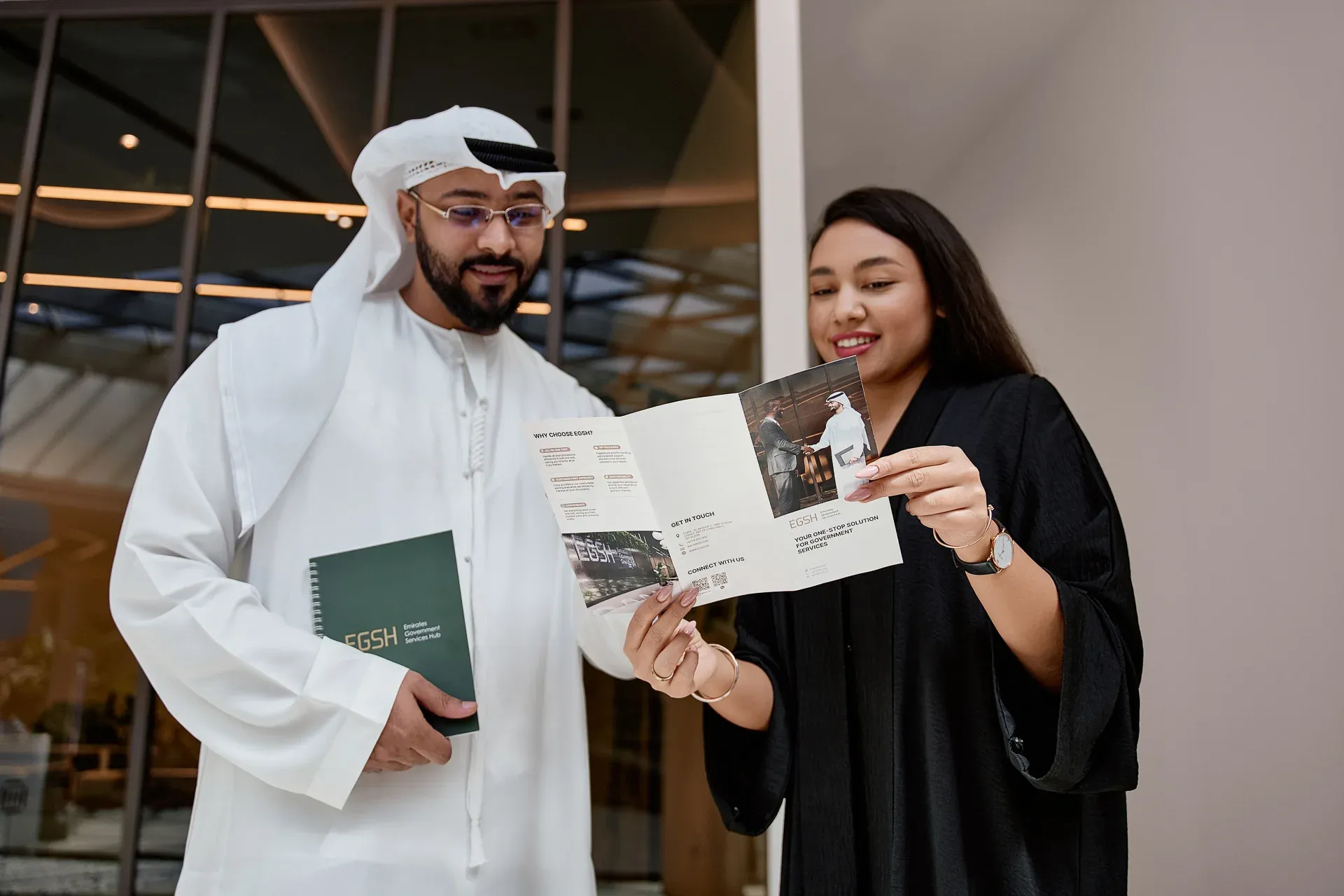
The Emirates Government Services Hub (EGSH) is an authorised Registration Trustee centre in Dubai where both the verification and the transfer of property ownership arising from divorce proceedings can be completed in a single visit.

Explore EGSH Government Services in Dubai
Legal Framework Governing Property Division in the UAE
The UAE does not apply a single statute to every divorcing couple. Two parallel legal tracks exist, determined primarily by the parties' religion and nationality.
Personal Status Law for Muslim Residents
Federal Decree-Law No. 41 of 2024, enforceable since 15 April 2025, replaced the former Federal Law No. 28 of 2005. It applies to UAE citizens where one or both parties are Muslim, and to non-citizen Muslims who do not request the application of their home country's legislation. Under this law, the court may refer the parties to the Family Guidance and Reconciliation Centre before a case reaches trial. If reconciliation fails, the supervising judge issues a referral to the Personal Status Court.

The core principle governing assets is set out in the law's provision on the financial independence of spouses: each has a separate financial entity, and neither may dispose of the other's property without consent. Where one spouse contributed to developing, building, or improving the other's property, that spouse is entitled to reclaim his or her share upon divorce. This claim is typically brought as a civil action, either within the divorce proceedings or separately.
Non-citizen Muslims residing in the UAE may request the application of their own national personal status laws, provided these do not conflict with UAE public order. This can significantly affect asset division — for instance, allowing a court to apply an equitable distribution regime rather than the separate property principle.

Get DLD Services in Dubai Through EGSH
Authorised One-Stop Government Services Centre
- All government services in one place
- Completed in one visit
- VIP service without queues
- Regulated government fees

Civil Personal Status Law for Non-Muslim Residents
Federal Decree-Law No. 41 of 2022 on Civil Personal Status, effective since 1 February 2023, applies to non-Muslim citizens and non-Muslim foreign residents unless they elect their home country's legislation. Under this law, either spouse may request divorce unilaterally, without proving fault, and the case proceeds directly to court without mandatory referral to the Family Guidance Committee.
Following a divorce judgment, the court may award alimony to the former spouse. The judge assesses the duration of the marriage, each party's financial position (via a court-appointed accounting expert), contributions to the family, including non-financial contributions such as childcare and domestic roles, and any physical or moral harm caused by the divorce. Non-Muslim couples may also agree on financial terms in the marriage contract, including provisions for property division, which the court will generally honour if the terms are fair, notarised, and independently advised.
The civil law does not create a default community property regime either, but it provides a broader framework for equitable financial adjustments after divorce, going beyond the Sharia-based model that focuses primarily on nafaqa (maintenance) and mahr (dowry).

The Separate Property Regime — How It Affects Asset Division
The overarching rule across both legal tracks is straightforward: property stays with whoever is named as the owner. The UAE does not recognise a concept of "marital estate" that would automatically entitle each spouse to a share of assets accumulated during the marriage.
In practical terms, this means the following. If a property in Dubai is registered at DLD in the husband's sole name, the wife has no automatic claim to a share of it purely by virtue of the marriage. Conversely, if a wife holds a title deed in her name, the husband cannot demand a portion. The critical exception is the contribution claim: where one spouse can prove, through bank transfers, construction invoices, or other documentary evidence, that he or she financed or participated in developing, purchasing, or improving the other's property, the contributing spouse has a legal right to claim compensation.
This differs materially from jurisdictions that practise equitable distribution, such as England or most Australian states, where a court may redistribute all assets regardless of registration. Couples who relocated to the UAE from such jurisdictions should be aware of this distinction and consider protective measures.

Joint Ownership and Its Implications
Where spouses hold property in joint ownership, both names appear on the title deed. Upon divorce, neither party can unilaterally sell or transfer the property without the other's consent. The resolution typically involves one of the following outcomes: one spouse buys out the other's share; both agree to sell the property and divide the proceeds; or the court orders a sale and apportions the funds. For properties registered with DLD, a formal partners division registration may be required to separate the co-owned interest into distinct titles before any transfer can proceed.
Property Held in Corporate Structures
Some couples hold real estate through companies or offshore vehicles. In such cases, the divorce court may not have direct jurisdiction over the corporate entity. The asset division may require a separate civil or commercial claim, and any resulting transfer of shares or assets must comply with the relevant free zone or DLD rules. A title deed verification through an authorised trustee centre such as EGSH is an important first step to confirming the current ownership structure before initiating divorce-related property claims.



Why Choose EGSH for Government Services in Dubai

VIP Service
Personal assistance and priority processing with no queues.

Affordable Fees
Official government rates with transparent, fixed pricing.

All Services in One Place
Comprehensive range of UAE government services under one roof.

One-Visit Completion
Most procedures are completed in a single visit to the centre.
Role of the Dubai Land Department in Post-Divorce Property Transfers
Once a divorce judgment or court-endorsed settlement agreement specifies that property must be transferred from one former spouse to the other, the execution of that order falls to DLD and its authorised Registration Trustee centres. DLD does not adjudicate the dispute; it registers the outcome.
Transfer Based on Court Order
The most common scenario involves a final, enforceable court judgment directing the transfer of a specific property. The party in whose favour the order was issued (or his or her legal representative) presents the judgment to a Registration Trustee centre, along with supporting documents. DLD verifies the judgment, confirms the property record, and issues a new title deed.
Transfer Based on Marital Settlement Agreement
Where the parties have reached an amicable agreement, either through the Family Guidance process or through private negotiation, and the court has endorsed that agreement, DLD will process the transfer on the basis of the endorsed settlement. The settlement must clearly identify the property by its DLD registration number, specify the outgoing and incoming owner, and be accompanied by the court's endorsement stamp or executory formula.
Gift Transfer Between Spouses Before Divorce Finalisation
Some couples choose to restructure ownership before or during divorce proceedings. If a spouse transfers property to the other as a gift while they are still legally married, DLD applies a reduced transfer fee of 0.125% of the property value, as the parties qualify as first-degree relatives.
However, if the same transfer occurs after the divorce is finalised, the parties are no longer considered relatives, and the standard 4% transfer fee applies. This timing distinction can represent a significant financial difference and requires careful coordination between the legal and registration stages. EGSH provides a dedicated property gift registration service for couples wishing to take advantage of the reduced rate before the divorce decree is issued.

Visit EGSH for VIP Service Without Queues
You can stop by EGSH during working hours without an appointment or book your visit at a time that suits you best.
Address
Art of Living Mall, Al Barsha 2, Dubai
Operating hours
Monday–Thursday, Saturday: 9:00 am–5:00 pm
Friday: 9:00 am–12:00 pm, 2:00 pm–5:00 pm
Sunday: Closed

Documents Required for Post-Divorce Property Transfer
The documentation required depends on whether the transfer is based on a court order, a court-endorsed settlement, or an agreement between the parties. The general requirements are set out below.
For a transfer based on a court order: the original court judgment in Arabic, bearing the executory formula; the Emirates ID of the transferee (or a valid power of attorney attested by the Ministry of Foreign Affairs and International Cooperation (MOFA) if the transferee is not present in the UAE); a copy of the existing title deed or DLD property reference number; passports of both parties (or passport copies for non-residents); the marital settlement agreement if the judgment refers to one; and a No Objection Certificate (NOC) from the property developer, where applicable.
For a gift transfer between spouses (pre-divorce): the original title deed; Emirates ID and passports of both parties; proof of the marital relationship (marriage certificate, attested and translated into Arabic); a DLD-approved property valuation certificate; a developer NOC; and payment of the applicable gift transfer fee.
All documents originating from outside the UAE must be attested by MOFA and, where applicable, by the relevant UAE embassy in the country of origin. Documents not in Arabic must be accompanied by a certified Arabic translation.
Where one party is represented by a third party, a notarised and attested power of attorney is required.

The Divorce Process and Property Claims — Step by Step
The following outlines the typical sequence of events from filing for divorce to completing the property transfer at DLD. Timelines are indicative and depend on case complexity, court scheduling, and whether the matter is contested.
Step 1 — Filing at the Family Guidance Section or Court
For Muslim residents, the process begins with the filing of a case at the Family Guidance and Reconciliation Centre of the relevant court (e.g., Dubai Courts). A family counsellor attempts reconciliation. If reconciliation fails, the centre issues a referral to the Personal Status Court. For non-Muslim residents under Federal Decree-Law No. 41 of 2022, the case may proceed directly to the court without mandatory reconciliation.
Step 2 — Court Proceedings and Asset Claims
During the court proceedings, either party may raise claims related to property division. The court does not automatically divide assets; it adjudicates claims. If a wife claims a share of a property registered in the husband's name, she must present evidence of her contribution — financial or otherwise. If the property is jointly owned, the court may order its sale or award one party's share to the other upon payment of compensation. The court may appoint a financial expert to evaluate each spouse's assets and income.

Step 3 — Issuance of the Divorce Decree and Settlement Terms
The court issues a divorce decree. If the parties have agreed on asset division, the settlement terms are incorporated into the decree or issued as a separate enforceable court document. If the matter is contested, the court renders a judgment specifying which assets belong to whom and any compensation payable.
Step 4 — Execution of the Property Transfer at DLD
Armed with the final judgment or endorsed settlement, the relevant party attends a Registration Trustee centre, such as EGSH, to execute the title deed transfer. The trustee verifies the court documents, confirms the property record, collects the applicable fees, and processes the issuance of a new title deed in the name of the receiving party. The process at the trustee office typically takes 25–30 minutes once all documents are in order.
Step 5 — Updating Ancillary Records
After the title transfer is complete, the new owner should update related records. These include Ejari registration if the property is tenanted, mortgage records if the property carries a loan that was assumed or discharged as part of the settlement, and any investor visa linked to the property. Where a change of name on the title deed is needed without a full transfer, for example, to reflect a legal name change following divorce, EGSH can facilitate a title deed amendment through the DLD system.

Prenuptial and Postnuptial Agreements
Prenuptial agreements offer the most effective mechanism for couples to define in advance how assets will be handled in the event of divorce. Under both the Personal Status Law and the Civil Personal Status Law, the terms of a prenuptial contract may be honoured by the court, provided the agreement meets certain conditions.
The agreement must be in writing. It should be notarised or attested. Both parties should have received independent legal advice. Full financial disclosure must have been provided by each party before signing. The terms must not be unconscionably one-sided or in conflict with mandatory provisions of UAE law, including those relating to mahr, maintenance, and children's rights.
Postnuptial agreements, entered into after marriage, are treated similarly. For non-Muslims under the civil track, such agreements carry significant weight, as the court can directly incorporate their terms into the divorce decree.
Couples who own or intend to purchase property in Dubai should consider formalising such agreements to avoid uncertainty. An agreement that specifies which properties belong to whom and how jointly owned assets will be divided can substantially simplify both the court proceedings and the subsequent DLD registration process. Further information on how ownership structures affect property protection is available in the guide on joint ownership versus inheritance rights for couples.

Related Government Services
Applying Foreign Law in UAE Divorce Proceedings
Both Federal Decree-Law No. 41 of 2024 and Federal Decree-Law No. 41 of 2022 allow non-citizen residents to request the application of their home country's legislation. This option can materially alter the outcome of asset division.
For example, a British couple divorcing in Dubai may request that English family law principles apply, which could entitle either spouse to a share of all assets, including those registered solely in the other's name. A Russian couple may invoke Russian family law, which generally treats assets acquired during marriage as joint marital property. However, the request is subject to the court's discretion: the foreign law must not conflict with UAE public order or morals, and the party requesting its application must formally prove its provisions by submitting certified, translated legal texts.
Where the court accepts the application of foreign law, the resulting judgment is then enforced domestically. If the judgment requires a property transfer in Dubai, the same DLD process applies: the party presents the court order to a Registration Trustee centre, and the title deed is reissued accordingly. The process for adding or removing a name from a title deed in Dubai remains the same regardless of which substantive law the court applied.

Common Misconceptions About Property Division in UAE Divorce
Several misunderstandings frequently arise in the context of divorce and property in the UAE. Clarifying these may help parties prepare more effectively.
The first misconception is that UAE courts divide assets equally between spouses. They do not. There is no 50/50 default. Property remains with the registered owner unless a contribution claim is proved or the parties agree otherwise.
The second is that a wife automatically receives a share of property registered in the husband's name. Under UAE law, the wife's rights upon divorce comprise mahr (dowry), maintenance during the idda (waiting period), and, in certain cases, post-divorce alimony. A share of real estate is not included unless the wife can prove financial contribution or the parties have a prenuptial agreement stipulating otherwise.

The third concerns the assumption that divorce proceedings automatically freeze or block property. A divorce filing does not result in an automatic DLD freeze on the property. If one party is concerned that the other may sell or encumber the property during proceedings, the concerned party must apply to the court for a provisional order restraining any dealings with the property. Once obtained, this order can be registered against the property at DLD. To confirm the current status and any encumbrances on a property before or during proceedings, a property ownership inquiry can be submitted through an authorised trustee centre.
The fourth is that court-endorsed settlements are not legally binding. In fact, a settlement agreement endorsed by the supervising judge carries the force of an enforceable instrument. However, it may be challenged on valid legal grounds, such as fraud, duress, or lack of legal capacity, within the applicable appeal timelines prescribed by law.

The Role of EGSH in Divorce-Related Property Transactions
The Emirates Government Services Hub (EGSH) operates as an authorised Real Estate Registration Trustee centre under the Dubai Land Department. For parties dealing with property changes arising from divorce, EGSH provides end-to-end registration services, including title deed verification to confirm current ownership status before proceedings begin, property valuation for settlement calculations, partners division registration to separate jointly owned properties, ownership transfer based on court orders or endorsed settlements, property gift registration for transfers between spouses at the reduced rate before the divorce decree is issued, and power of attorney attestation for parties unable to attend in person.
All services are processed at official government fees. EGSH's role is limited to facilitating government transactions; it does not provide legal advice, represent parties in court, or make determinations on property entitlements. Final approvals for all property registrations are issued by the Dubai Land Department.

Frequently Asked Questions
How is property divided in a divorce in the UAE?
The UAE applies a separate property regime. Each spouse retains the assets registered in his or her name. There is no automatic equal split. A spouse who contributed to developing or purchasing the other's property may file a civil claim for his or her share, supported by documentary evidence.
Can a wife claim property registered in the husband's name in Dubai?
Only if the wife can prove that she financially contributed to the acquisition, improvement, or development of the property. Without such proof, the property remains with the registered owner. A prenuptial agreement may also stipulate the wife's entitlement to specific assets upon divorce.
Does UAE law split property 50/50 in divorce?
No. The UAE does not have a community property or equitable distribution regime as a default. Each spouse keeps what is registered in his or her name. Courts may order compensation for a proven financial contribution but will not redistribute ownership equally.
What fees apply to property transfer after divorce in Dubai?
Fees depend on the type of transfer. A gift transfer between legally married spouses attracts a reduced fee of 0.125% of the property value. A standard post-divorce transfer (where parties are no longer classified as relatives) is subject to the regular 4% DLD transfer fee plus administrative charges. Court-ordered transfers may have different fee arrangements.
Can expats apply foreign law to property division in a UAE divorce?
Yes. Both Muslim and non-Muslim foreign residents may request the application of their home country's personal status laws, provided these do not contravene UAE public order. The requesting party must formally prove the foreign law's provisions with certified, translated documents.
How to transfer property after divorce in Dubai?
After obtaining a final divorce decree or court-endorsed settlement specifying the property transfer, the receiving party (or his or her representative holding a valid power of attorney) attends a Registration Trustee centre such as EGSH. The court documents, identification, and applicable fees are submitted, and a new title deed is issued.
Do prenuptial agreements protect property in UAE divorce?
Prenuptial agreements are recognised under UAE law and can be enforced by the court if they are in writing, notarised, fair, freely entered, and do not conflict with mandatory legal provisions such as mahr and children's maintenance. They provide the most reliable mechanism for pre-defining property rights.
What happens to jointly owned property in divorce in Dubai?
Jointly owned property cannot be unilaterally sold by either party. The resolution may involve one spouse buying out the other's share, a court-ordered sale with proceeds divided, or a formal partners division registration at DLD to separate the co-owned interest.

Official Sources and References
The following government authorities and legislative texts were referenced in this article.
- The Federal Authority for Identity, Citizenship, Customs and Port Security (ICP) — https://icp.gov.ae — Federal authority responsible for visa and residency regulation.
- The Dubai Land Department (DLD) — https://dubailand.gov.ae — Government authority responsible for property registration and real estate regulation in Dubai.
- Dubai Courts — https://www.dc.gov.ae — Judicial authority responsible for personal status and family cases in the Emirate of Dubai.
- The Ministry of Foreign Affairs and International Cooperation (MOFA) — https://www.mofa.gov.ae — Federal authority responsible for document attestation.
- Federal Decree-Law No. 41 of 2024 on the Issuance of the Personal Status Law — https://uaelegislation.gov.ae/en/legislations/2770 — Replaces Federal Law No. 28 of 2005; applies to Muslim residents and UAE citizens.
- Federal Decree-Law No. 41 of 2022 on Civil Personal Status — https://uaelegislation.gov.ae/en/legislations/1586 — Applies to non-Muslim residents; introduced civil divorce and no-fault separation.
H2: Important Notice
The information provided in this article is current as of March 2026 and is intended for general guidance only. UAE legislation, government fees, and administrative procedures are subject to change without prior notice. All property-related approvals, registrations, and transfers are ultimately issued by the Dubai Land Department or the relevant competent authority. EGSH facilitates government transactions through its authorised departments but does not issue approvals, guarantee outcomes, or provide legal representation. Readers are advised to verify all applicable requirements, fees, and procedures directly with the relevant government authority or to seek independent legal counsel before making decisions related to property division during divorce.



