


About EGSH
What This Comparison Covers
Buying a property in Dubai requires a minimum upfront payment of approximately 7–10% of the purchase price in government fees and transaction costs, anchored by the 4% DLD transfer fee. Renting requires Ejari tenancy registration, a refundable security deposit, and agent commission, but no government transfer tax. Each path carries distinct financial, legal, and lifestyle implications that depend on factors specific to the individual: investment horizon, access to mortgage financing, salary structure, and residency objectives.
This guide compares the two options across six dimensions: upfront costs, recurring expenses, mortgage financing rules, tenancy regulation, residency visa eligibility, and long-term financial outcomes. All fees and thresholds are based on current schedules published by the DLD, the Real Estate Regulatory Agency (RERA), and the Central Bank of the UAE (CBUAE).
Register Property Ownership Transfer in Dubai
Officially regulated fees
No hidden charges
Queue-free service
VIP support at no extra cost
From AED 2,100
Get DLD Services in Dubai Through EGSH
Authorised One-Stop Government Services Centre
- All government services in one place
- Completed in one visit
- VIP service without queues
- Regulated government fees



Why Choose EGSH for Government Services in Dubai

VIP Service
Personal assistance and priority processing with no queues.

Affordable Fees
Official government rates with transparent, fixed pricing.

All Services in One Place
Comprehensive range of UAE government services under one roof.

One-Visit Completion
Most procedures are completed in a single visit to the centre.
Upfront Costs of Renting Property in Dubai
Renting in Dubai requires significantly lower upfront capital. The primary costs are a refundable security deposit (typically 5% of the annual rent for unfurnished properties or 10% for furnished), agent commission of 5% of the annual rent, and Ejari tenancy registration through the DLD's official system.
Ejari registration costs AED 120 when processed online through the Dubai REST app or DLD portal, covering the AED 100 base government fee, AED 10 Knowledge Fee, and AED 10 Innovation Fee. Registration through a Real Estate Services Trustee Centre such as EGSH costs approximately AED 220–230, including the service partner fee and VAT. The DEWA security deposit for a new residential connection is AED 2,000 for apartments and AED 4,000 for villas.

Recurring Costs: Ownership vs Tenancy
Property owners in Dubai pay annual service charges to the owners' association (OA) or the developer's management company. These charges cover maintenance of communal areas, security, landscaping, and building insurance. Rates vary by community and building quality, typically ranging from AED 13–28 per square foot in apartment towers to AED 2–6 per square foot in villa communities. Service charges are recorded and billed through the DLD's Mollak system.
Dubai does not levy annual property tax, capital gains tax, or income tax on rental yields. This absence of recurring taxation is a structural distinction from most global property markets and is a significant factor in the financial calculation for expat buyers.
Tenants pay rent and utility charges (DEWA for electricity and water, plus a 5% municipality housing fee calculated on the annual rent, charged monthly via the DEWA bill). Ejari renewal is required annually and follows the same fee structure as new registration. Rent adjustments at renewal are regulated by Decree No. 43 of 2013, which caps increases based on how far the current rent falls below the RERA Smart Rental Index benchmark for comparable units.
Visit EGSH for VIP Service Without Queues
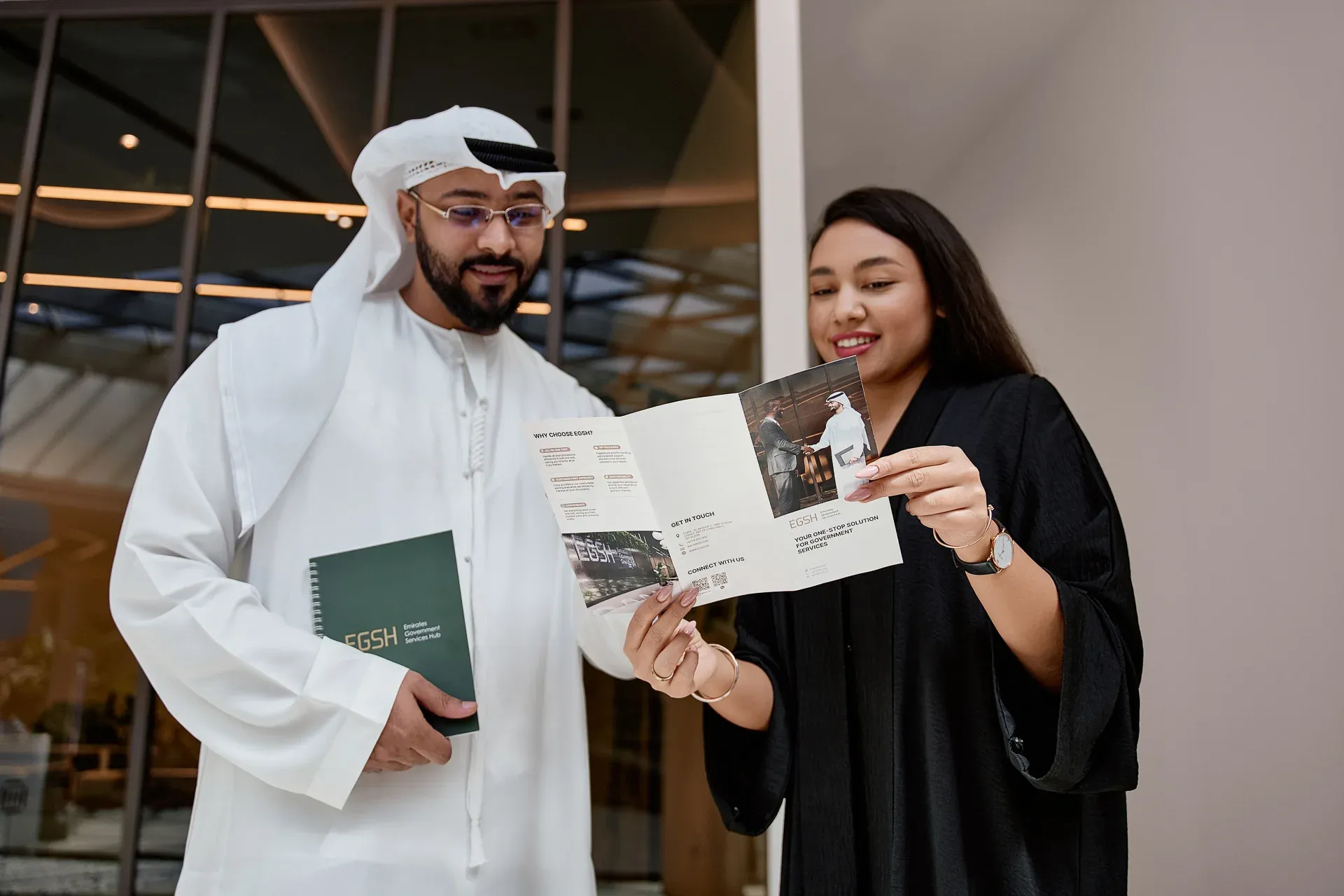
You can stop by EGSH during working hours without an appointment or book your visit at a time that suits you best.
Address
Art of Living Mall, Al Barsha 2, Dubai
Operating hours
Monday–Thursday, Saturday: 9:00 am–5:00 pm
Friday: 9:00 am–12:00 pm, 2:00 pm–5:00 pm
Sunday: Closed

Residency Visa Eligibility Through Property Ownership
Property ownership in Dubai unlocks residency visa routes that are not available to tenants. Two categories apply to real estate investors, each with distinct value thresholds and validity periods.
The 2-year renewable investor residence visa is available under the DLD Taskeen programme for properties valued at AED 750,000 or above. The applicant must have paid at least AED 750,000 of the purchase price and demonstrate a monthly income of at least AED 15,000. The 2-year investor visa covers the holder and allows sponsorship of dependants under standard GDRFA rules.
The 10-year Golden Visa for property investors requires ownership of property with a total value of at least AED 2,000,000, as certified by a DLD valuation certificate. Mortgaged properties are accepted, provided the financing bank issues a no-objection certificate. A comprehensive overview of both pathways, including fee breakdowns and document checklists, is available in the minimum property value for UAE residence visa.

Since February 2026, the previous requirement for at least AED 2,000,000 to have been paid has been removed for Golden Visa applicants. The qualifying criterion is now the total property value as certified by the DLD, regardless of the outstanding mortgage balance. A detailed explanation of the Golden Visa programme covers all investor, professional, and entrepreneur categories.
Tenants do not qualify for a property-based residence visa. Tenancy alone does not confer any immigration benefit in the UAE.
When Buying Makes Financial Sense
Purchasing property in Dubai is generally more advantageous when the buyer plans to remain in the emirate for five years or more, has sufficient capital to cover the upfront transaction costs without straining liquidity, and intends to benefit from equity accumulation in a tax-free environment. The absence of annual property tax, capital gains tax, and personal income tax means that the holding cost of ownership is lower in Dubai than in most comparable international markets.

Buyers who finance through a mortgage should compare the total monthly repayment (principal plus interest) against the equivalent rent for a comparable property. In many established communities, monthly mortgage repayments on an 80% LTV loan are comparable to or lower than equivalent rental payments, particularly for mid-market apartments in areas such as Jumeirah Village Circle, Dubai Sports City, and Dubai Silicon Oasis.
Property ownership also provides a pathway to the 2-year investor visa or the 10-year Golden Visa, both of which carry practical benefits: the ability to sponsor family members, open bank accounts, and register businesses. Investor visa renewal requires that the qualifying property remains registered under the investor's name and continues to meet the applicable value threshold.
When Renting Is the Better Option
Renting is typically more suitable for expats who are new to Dubai and still assessing their preferred community, those on short- to medium-term employment contracts (under three years), or individuals who prefer to deploy capital in other investments rather than committing 20–30% of a property's value as a down payment.
Dubai's tenancy framework provides meaningful protections. Law No. 26 of 2007 and its amendments regulate the landlord–tenant relationship, including eviction grounds, notice periods, and maintenance obligations. Rent increases are capped under Decree No. 43 of 2013, and tenants can verify proposed adjustments using the RERA Smart Rental Index through the Dubai REST app or DLD website.
The financial flexibility of renting allows expats to relocate between communities without incurring the 4% DLD transfer fee and associated transaction costs that apply each time a property changes hands. For short-term residents, the cumulative transaction cost of buying and reselling within one to three years often exceeds the total rent paid during the same period.

How EGSH Facilitates Property and Tenancy Procedures
EGSH — Emirates Government Services Hub — is a government-authorised centre in Dubai operating as a Real Estate Registration Trustee Centre, Real Estate Services Trustee Centre, and licensed AMER Centre. The centre is directly integrated with DLD, GDRFA, and ICP systems.
For property buyers, EGSH processes ownership transfers, title deed issuance, property valuation applications, mortgage registrations, and investor visa applications through official DLD and GDRFA channels. The full property registration procedure is completed at the centre in a single appointment.

For tenants, EGSH handles Ejari tenancy registration and renewal, Ejari cancellation, and related DLD services as an authorised Real Estate Services Trustee Centre. All services are processed at government-regulated fees.
All approvals — whether for property transfers, residence visas, or tenancy registrations — are issued by the relevant UAE government authority. EGSH facilitates applications through official channels but does not issue government approvals.

Frequently Asked Questions
What are the total costs of buying a property in Dubai as an expat?
Total buyer costs typically range from 7–10% of the purchase price for a cash transaction, or 8–11% when financed through a mortgage. The largest component is the 4% DLD transfer fee, followed by the trustee office fee, title deed issuance, agent commission, and mortgage-related charges where applicable.
Is there an annual property tax in Dubai?
Dubai does not impose annual property tax, capital gains tax, or personal income tax on rental income. Property owners pay annual service charges to the owners' association, which cover communal area maintenance, and a 5% municipality fee applies on residential rental income (collected via DEWA for tenants).
What is the minimum down payment for an expat buying property in Dubai?
The CBUAE mortgage regulations require expatriates to pay a minimum of 20% for a first property valued under AED 5 million and 30% for properties above AED 5 million. Off-plan properties require a 50% down payment regardless of buyer category.
How much does Ejari registration cost in Dubai?
Ejari registration costs AED 120 online through the Dubai REST app or DLD portal (AED 100 base fee plus AED 10 Knowledge Fee and AED 10 Innovation Fee). Through a Real Estate Services Trustee Centre such as EGSH, the total is approximately AED 220–230 including the service partner fee and VAT.
Can I get a UAE residence visa by buying property in Dubai?
Property investors who purchase real estate valued at AED 750,000 or above qualify for a 2-year renewable residence visa. Those who own property worth AED 2,000,000 or more qualify for a 10-year Golden Visa. Both routes are administered through the DLD in coordination with the GDRFA and ICP.
How are rent increases regulated in Dubai?
Rent increases at lease renewal are governed by Decree No. 43 of 2013. The maximum permitted increase ranges from 0% to 20%, determined by how far the current rent falls below the RERA Smart Rental Index benchmark for comparable units. Landlords must provide at least 90 days' written notice.
Is it cheaper to rent or buy in Dubai over five years?
The answer depends on the purchase price, financing terms, and rent levels in the chosen community. In many mid-market areas, total ownership costs over five years — including the 4% DLD fee, mortgage interest, and service charges — are comparable to or lower than cumulative rent, with the added benefit of equity accumulation and a tax-free holding environment. A property-specific calculation is required.
What documents do I need to register a tenancy contract in Dubai?
Ejari registration requires a signed unified tenancy contract, the landlord's title deed copy, Emirates ID of the tenant (and landlord if applicable), a DEWA premise number, and a valid passport. The process can be completed online through the Dubai REST app or at an authorised Real Estate Services Trustee Centre.

Explained by
Omar Abdulaziz Ali Al Qassim
Government Services Center Manager / Legal Consultant
Omar Abdulaziz Ali Al Qassim is a Government Services Center Manager and Legal Consultant with 8 years of experience. He specialises in real estate, licensing, residency, labour, and Ejari services, ensuring accurate and compliant processing across DLD, MOHRE, GDRFA, and DET systems.
Official Sources and References
The information in this article is based on the following official UAE government sources.
Dubai Land Department (DLD) — Government authority responsible for property registration, ownership transfers, Ejari tenancy registration, and the RERA Smart Rental Index.
Real Estate Regulatory Agency (RERA) — Regulatory arm of the DLD responsible for licensing real estate practitioners, publishing the rental index, and enforcing tenancy regulations.
Central Bank of the UAE (CBUAE) — Federal authority setting mortgage lending regulations, including LTV ratios, DBR limits, and maximum loan terms.
Dubai Legislation Portal — Official repository for emirate-level legislation, including Decree No. 43 of 2013 and Law No. 26 of 2007 on landlord–tenant regulation.
Federal Authority for Identity, Citizenship, Customs and Port Security (ICP) — Federal authority administering visa and residency services, including the Golden Visa programme.
General Directorate of Residency and Foreigners Affairs (GDRFA) — Dubai's immigration authority responsible for residency permits, entry permits, and investor visa processing.
UAE Government Portal — Central federal portal providing guidance on property ownership, visa types, and residency requirements.
Important Notice
The information in this article reflects Dubai Land Department fee schedules, Central Bank of the UAE mortgage regulations, and RERA tenancy rules current at the time of publication. Government fees, regulatory thresholds, and procedural requirements are subject to change without prior notice. All property transactions and visa applications are subject to approval by the relevant UAE government authority. EGSH facilitates applications through official government channels but does not issue title deeds, residence visas, or government approvals. Prospective buyers and tenants should verify the latest requirements directly with the DLD, CBUAE, or the relevant authority before making financial commitments.



